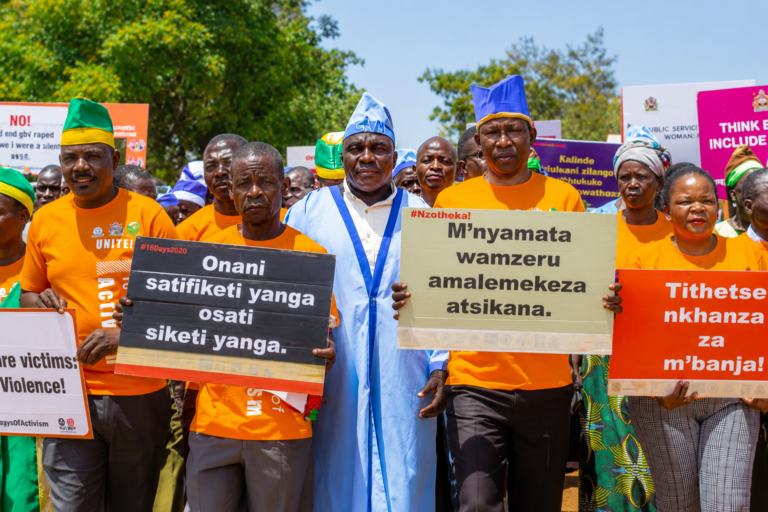




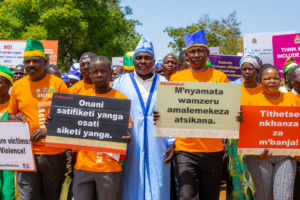
As Malawi marks the 16 Days of Activism, a period dedicated to confronting the realities of gender-based violence (GBV), the conversation is beginning to shift toward an often overlooked but essential truth: men are not only part of the problem, they are also an indispensable part of the solution.
A 2021 Annual Gender-Based Violence Disaggregated Data report in Malawi indicated that 3,053 men were abused countrywide out of 16,301 female and 4,239 male victims representing 20.6% of total victims
While women’s voices and experiences rightly remain at the centre of GBV advocacy, the country’s efforts cannot succeed without deliberately engaging men in dismantling the social norms, power structures, and digital behaviours that fuel violence.
The launch of the National Male Engagement Strategy (NMES 2023-2030) on July 12th and 13th, 2023 by the Ministry of Gender, Community Development and Social Welfare, signified this shift, offering a framework that intentionally positions men as vital partners in advancing gender equality.
The strategy emphasizes healthier models of masculinity, accountability and respect values that leaders like Marcel Chisi of Men for Gender Equality Now (MEGEN) argue are urgently needed if Malawi is to reduce the violence largely perpetrated by men.
Chisi stresses that male involvement in GBV work is not about protecting men’s interests, but about addressing the root causes of violence, noting that, “majority of violence, a good number of reported violence cases, are actually perpetrated by men. We want to make sure that men not only become perpetrators, but also a solution to addressing GBV.”
For him, part of this solution lies in transforming how men understand relationships and power, especially online.
“Men want to be seen to own women, and that’s why when a relationship ends, they begin to continue to stalk on that woman.
And yet, they do not have to control the women.”
This is where positive masculinity becomes essential.
“Positive masculinity is where you understand that it is okay to be a man, even if you don’t resort to violent forms of solving conflicts. It is okay to be a man not to abuse women and children.’
Government echoes this call for shared responsibility.
Minister of Gender Mary Navitcha emphasises the significance of observing 16 Days of activism as this serves as a national platform to raise awareness, strengthen national and community engagement.
She noted that this provides a forum for dialogue and strategy sharing for preventing and responding to gender-based violence.
Navicha highlights the alarming rise of digital violence, stating that about one in three children experience cyber bullying and women and girls are increasingly exposed to online harassment, image-based abuse, sexual exploitation, gendered misinformation and other forms of digital violence.
Meanwhile, civil society organisations warn that despite the growing awareness, digital spaces remain unsafe for many women.
Maggie Kathewera Banda of the NGO Gender Coordination Network notes that the campaign has succeeded in expanding public understanding. But cautions that the country must move beyond awareness to accountability, especially in the online sphere.
Banda stresses that “there’s a lot of GBV taking place in the cyber space most of the times it is women who are attacked. Let’s use the digital tools responsibly.’
Law enforcement is also adapting to these new challenges.
According to Malawi Police Service Deputy Publicist, Alfred Chimthere, cyber-related GBV is increasing, with about 11,006 cases recorded in just six months.
Chimthere explains that the police are strengthening their capacity to respond to digital offences through victim support units, cybercrime experts, and digital forensics teams.
Alongside these perspectives, some voices call for a deeper re-examination of how society frames the conversation around GBV.
Watson Shawa, who is the chief executive of Men Arise Now stresses the need to broaden understanding.
“For along time, we’ve been portraying men as the perpetrators, and the poor women as victims of GBV. It’s not the truth. The truth is it’s both ways”.
Shawa says both sides have got victims, and both sides have got perpetrators.
He says this perspective argues that societal assumptions often overlook male victimhood.
“There’s a false belief that men can never be victimized, they can never be beaten by women, and that men are stronger than women. But records are proving otherwise’.
His argument extends to a call for redefining how Malawians understand gender, noting, “In Malawi, we perceive gender as women issues, but not it. It’s about the diversity of the sexes we are born into.”
There is also a concern that men feel isolated from gender discussions as a result, they have been very cautious and apprehensive about accommodating the gender subject.
Across government, civil society, police, and community voices, one message resonates clearly: men must be actively involved in preventing violence and reshaping the norms that sustain it.
Their voices, influence and behaviour have the power to either entrench the problem or accelerate the solution.
As Malawi observes the 16 Days of Activism, the role of men becomes undeniable. Transforming harmful masculinities, standing against abuse among peers, and supporting survivors are not acts of charity but responsibilities rooted in justice.
The path toward ending GBV offline and online depends on men choosing to become allies, leaders, and champions of equality.