


Tears flowed. Songs rose. Memories lingered.
Then came the final moment.
The coffin was lifted.
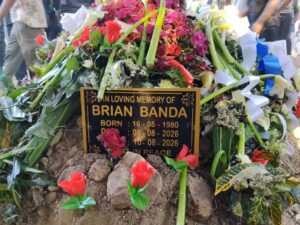
Slowly, it was carried towards the grave at Msungwi Graveyard as thousands of mourners watched. Some stood motionless. Others wiped away tears. A few could not hold them back.
Then the coffin was lowered.
Into the grave went the man whose voice had for years travelled through Malawi’s airwaves. The journalist. The interviewer. The broadcaster. The former presidential press secretary. The Director General of the Malawi Broadcasting Corporation (MBC).
Soil followed.
One handful at a time.
For a moment, the songs from Word of Faith Church seemed to compete with the silence of grief hanging over M’banda Village in T/A Kuntaja, Chileka, Blantyre.
The finality of the moment was impossible to escape.
Brian Banda was home.
Thousands of mourners from all walks of life had gathered to escort the 45-year-old media icon to his final resting place, bringing together family members, friends, journalists, politicians, government officials, church leaders and colleagues who came to honour a man whose career touched some of Malawi’s most important institutions.
At the funeral ceremony, held opposite Nanjayiko Residence, named after Banda’s grandmother, tributes painted a picture of a journalist who was not afraid to ask difficult questions, a communicator who moved comfortably between the newsroom and the political establishment, and a media leader whose career stretched from private broadcasting to the country’s public broadcaster.
The congregation sang songs of hope.
But grief had its own voice.
Mourners wept as speaker after speaker stood to remember Banda, whose death has left Malawi’s media fraternity grappling with the loss of one of its most recognisable voices.
For a man whose professional life revolved around questions, conversations and public accountability, his final journey was marked not by another interview or broadcast, but by the quietest conversation of all: a farewell.
A father, a husband, a pillar of strength
President Peter Mutharika has described the late Malawi Broadcasting Corporation (MBC) Director General Brian Banda as a distinguished media personality and dedicated public servant.https://t.co/g3tENwAVWU
— Capital FM Malawi (@CapitalFMMw) August 8, 2026
For Banda’s family, however, the man being mourned was much more than the public figure known to millions of Malawians.
He was a husband.
A father.
And a source of strength.
Speaking on behalf of the children of the departed MBC Director General, his son Hope described his father as a pillar of strength who would be dearly missed.
The tribute captured the deeply personal dimension of a death that has largely been discussed in terms of Banda’s public career.
Behind the journalist who challenged politicians and the broadcaster who led MBC for only four months was a father whose absence has now created a permanent space in the lives of his six children.
Banda is survived by his wife, Linda, and six children.
A journalist who asked difficult questions
For Malawi’s media fraternity, one of the strongest themes to emerge from the funeral was Banda’s courage as a journalist.
Chairperson of the Malawi Chapter of the Media Institute of Southern Africa, Felix Washoni, urged journalists to emulate Banda’s clear boldness in holding duty bearers accountable.
That description speaks to a defining feature of Banda’s journalism.
He was not simply interested in getting people to speak.
He was known for pushing them to answer.
His interviews often placed public officials under scrutiny, reflecting the traditional watchdog role of journalism in a democracy.
Washoni’s message therefore went beyond remembering Banda. It was also a challenge to the journalists he leaves behind: that the profession should not lose its courage simply because one of its prominent practitioners is gone.
‘A contribution to Malawi’s democracy’
The ruling Democratic Progressive Party also joined the tributes.
Its Secretary General, Peter Mukhito, in his eulogy said Banda’s exceptional journalistic skills contributed to building Malawi’s democracy.
The comment reflects the unusual space Banda occupied in Malawi’s public life.
His career did not remain confined to the newsroom. He worked across journalism, political communication and public broadcasting, giving him a front-row seat to the country’s political and democratic developments.
Through those different roles, he interacted with politicians, presidents, government officials and ordinary Malawians.
His work therefore placed him at the heart of the country’s public conversation.
‘A unique gift’ for tough questions
Speaking on behalf of President Professor Arthur Peter Mutharika, Chief Secretary to the Office of the President and Cabinet Justin Saidi said Banda had a “unique gift” for asking tough questions of authorities.
According to Saidi, that quality was among the attributes that inspired President Mutharika to appoint Banda as Director General of MBC.
From asking questions of those in authority, he eventually found himself leading one of the country’s most important public communication institutions.
As MBC Director General, Banda inherited responsibility for an institution whose mandate extends across radio, television and public information.
His appointment also demonstrated the extent to which his professional journey had evolved from the traditional newsroom into senior positions within the country’s political and media establishment.
From Capital Radio to State House and MBC
Banda’s career was marked by several major transitions.
He worked with Capital Radio and the Times Group before entering political communication.
He later served as Press Secretary to former Presidents Joyce Banda and Lazarus Chakwera.
His experience in those positions gave him an understanding of political communication from a different side of the microphone.
He had moved from questioning those in power to advising those in power.
And eventually, he returned to the media leadership space as Director General of MBC.
That trajectory made Banda a distinctive figure in Malawi’s media landscape.
He understood the current affair.
He understood political communication.
And he understood the pressures that come with leading a national broadcaster.
Endurance in the face of challenges
Mulanje Central MP, Kondwani Nankhumwa, who worked with Banda at MBC before entering politics in 2009, urged young journalists to emulate his spirit of endurance.
The message was particularly significant for a younger generation of journalists navigating an industry undergoing rapid transformation.
For Nankhumwa, Banda’s career offered lessons in resilience and commitment to duty, particularly when working in an environment where journalists can face political, professional and institutional pressures.
MACRA joins the farewell
The Malawi Communications Regulatory Authority also joined the nation in paying its final respects.
MACRA Board Chairperson Counsel Chancy Gondwe and Director General Mayamiko Nkoloma led the Authority’s delegation to the funeral.
They joined senior government officials, media practitioners, church leaders, family members and friends in honouring Banda.
MACRA said its presence reflected the Authority’s recognition of Banda’s significant contribution to Malawi’s media and broadcasting industry.
It also expressed solidarity with the MBC family, Banda’s colleagues and the bereaved family.
His death was not simply being mourned within MBC.
It was being felt across Malawi’s wider communications and media sector.
A life cut short
Brian Banda was born in 1981.
He died on Saturday, August 8, 2026, at Mwaiwathu Private Hospital in Blantyre after a short illness.
He was 45.
But on Monday, none of his titles could change the reality confronting the mourners at M’banda Village.
The coffin was in the ground.
The songs had begun to fade.
The speeches were over.
The crowd that had gathered to say goodbye would eventually leave.
But the questions remained.
Who will fill the space left by a journalist known for asking difficult questions?
Who will carry forward the courage to hold duty bearers accountable?
And how will the next generation of journalists preserve the values that colleagues and friends associated with Brian Banda?
Those questions now form part of his legacy.
Brian Banda leaves behind a wife, six children, colleagues, friends and a media fraternity that must now learn to tell Malawi’s stories without one of its most familiar voices.
The microphone has gone silent.
But the questions he asked will remain.
May his soul rest in peace.